Air in Space — Air Occupies Space and Exerts Pressure – Primary 1 Basic Science Lesson Note

TOPIC: Air in Space
SUBTOPIC: Demonstrating that Air Occupies Space and Exerts Pressure
CLASS: Primary 1
DATE: ___________________________
PERIOD: _________________________
DURATION: 40 minutes
LEARNING OBJECTIVES
By the end of the lesson, pupils should be able to:
- Demonstrate that air occupies space.
- Show that air exerts pressure.
- Explain in simple terms how air fills empty spaces around us.
KEY VOCABULARY WORDS
Space, Pressure, Fill, Empty, Balloon, Bottle, Air, Push.
INSTRUCTIONAL MATERIALS
- Balloons
- Plastic cups or bottles
- Bowl of water
- Pictures/charts showing air in objects (e.g., tyres, balloons)
- Polythene bags
INTRODUCTORY ACTIVITY
- The teacher displays a deflated balloon and asks: “What happens when I blow air into this balloon?”
- Pupils respond: “It becomes big!”
- The teacher asks: “What filled the balloon?”
- Pupils answer: “Air!”
- The teacher then explains that air occupies space — that means it fills any empty place where it enters.
CONTENT OF THE LESSON
Air Occupies Space
Air takes up space wherever it is found.
When we blow air into a balloon, it fills the balloon.
When we push a cup upside down into water, the air inside stops water from entering fully.
This shows that air occupies space.
Simple Experiment 1:
- Take an empty plastic bottle and try to put it into water with the mouth facing down.
- You will see bubbles coming out.
- The bubbles show that air is inside the bottle, taking up space.
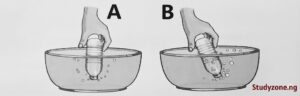
(Diagram: Bottle in water showing bubbles escaping)
Air Exerts Pressure
Air can push things; this is called air pressure.
When we blow air into a balloon, it pushes the walls of the balloon and makes it stretch.
Air pressure helps kites to fly and tyres to move vehicles.
Simple Experiment 2:
- Blow air into a balloon.
- Release it without tying the end.
- Watch the balloon fly around.
- It moves because air pressure pushes it.
(Illustration: Balloon flying around when air escapes)
Summary
FACT | EXPLANATION |
Air occupies space | It fills balloons and bottles. |
Air exerts pressure | It pushes objects when released. |
Air is everywhere | Around us, in bottles, tyres, and even our lungs. |
CLASS EXERCISE 1
Fill in the blanks:
- Air takes up _______.
- When you blow a balloon, air fills the _______.
- Air can push things. This is called air _______.
- When we turn a cup upside down in water, bubbles show there is _______ inside.
- We cannot see air, but it is _______ us.
CLASS EXERCISE 2
Match the pictures (or items) to what air does:
ITEM | WHAT AIR DOES |
Balloon | Makes it big |
Tyre | Helps it move |
Kite | Helps it fly |
Cup in water | Shows air is inside |
Hand fan | Moves air around |
ASSIGNMENT (Multiple-Choice Questions)
Choose the correct answer and write the letter of the correct option.
- Air takes up _______. (a) Space (b) Time (c) Colour (d) Shape)
- When you blow a balloon, it becomes _______. (a) Empty (b) Bigger (c) Smaller (d) Flat)
- The bubbles from a cup in water show that there is _______. (a) Stone (b) Air (c) Sand (d) Water)
- When air pushes something, we say air exerts _______. (a) Colour (b) Pressure (c) Shape (d) Weight)
- Air is found _______. (a) Only in bottles (b) Everywhere (c) In the sea only (d) In food)