Soil II — Discovering What’s Inside Soil and Its Importance – Primary 1 Basic Science Lesson Note

TOPIC: Soil II
SUBTOPIC: Things Found in Soil and Importance of Soil
CLASS: Primary 1
DATE: ___________________________
PERIOD: _________________________
DURATION: 40 minutes
LEARNING OBJECTIVES
By the end of the lesson, pupils should be able to:
- List the things found in soil (such as air, water, and living things).
- State the uses of soil to plants, animals, and human beings.
- Demonstrate that soil contains living and non-living things.
KEY VOCABULARY WORDS
Soil, Water, Air, Worm, Ant, Plant, Root, Dig, Grow.
INSTRUCTIONAL MATERIALS
- Samples of soil in bowls or containers
- Small hand trowel or spoon for digging
- Magnifying glass or simple hand lens (optional)
- Pictures/charts showing soil animals (worms, ants) and plant roots
- Real objects: water, small stones, leaves
INTRODUCTORY ACTIVITY
- The teacher takes pupils outside to collect small soil samples.
- Pupils observe the soil closely using their eyes or magnifying glass.
- The teacher asks: “What do you see inside the soil?”
- Pupils mention things like stones, small insects, water, or roots.
- The teacher explains: “Good! These are the things found in soil.”
CONTENT OF THE LESSON
Things Found in Soil
When we look closely at soil, we can find many things inside it. These things make soil very useful and alive.
Things Found in Soil | Examples / Description |
Air | It is found between soil particles. It helps plants and small animals to breathe. |
Water | It keeps the soil wet and helps plants to grow. |
Living things | Examples are worms, ants, and roots of plants live in the soil. |
Non-living things | Examples are stones, sand, and pieces of leaves can be found in soil. |
🪱 Activity:
Let pupils dig and observe their soil samples.
Ask:
- “Can you see any small insects?”
- “What happens when we pour water into the soil?”
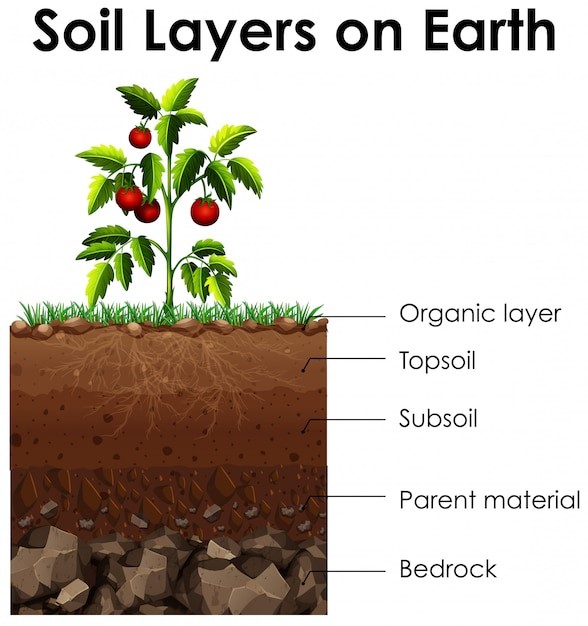
Diagram showing layers of soil with roots, worms, stones, and water droplets
Importance of Soil
To Plants | To Animals | To Human Beings |
1. It provides support for roots | 1. Some animals live in it (worms, ants) | 1. It is used for building houses |
2. It supplies nutrients and water | 2. Some animals find food there | 2. It is used to make pots and plates |
3. It helps plants to grow | 3. It gives protection from sun and rain | 3. It is used for farming and playing |
💡 Discussion:
Ask pupils:
- “Can plants grow without soil?”
- “What do we use sand for at home?”
- “Where do worms and ants live?”
Summary
- Soil contains air, water, and living things.
- Soil is important to plants, animals, and humans.
- We must not throw dirt or waste on soil because we get food and shelter from it.
CLASS EXERCISE 1
Fill in the blanks:
- Soil contains _______ and water.
- _______ and ants live in the soil.
- Soil helps _______ to grow.
- We use soil to build _______.
- Soil gives animals a place to _______.
CLASS EXERCISE 2
Match each group to the correct use of soil:
GROUP | USE |
Plants | Grow and get food from soil |
Animals | Live and hide in soil |
Humans | Build houses with soil |
Worms | Live and move inside soil |
Clay | Used to make pots |
ASSIGNMENT (Multiple-Choice Questions)
Choose the correct answer and write the letter of the correct option.
- Which of these can we find in soil? (a) Air (b) Sugar (c) Plastic (d) Paper)
- Worms and ants are _______. (a) Stones (b) Living things (c) Water (d) Roots)
- Plants grow well in _______. (a) Soil (b) Metal (c) Glass (d) Plastic)
- Soil helps people to _______. (a) Sleep (b) Build houses (c) Fly (d) Swim)
- We should keep the soil _______. (a) Dirty (b) Wet (c) Clean (d) Covered with waste)