Moving Our Boby (Part 1)

Moving Our Body Parts (Part 1)
Primary 1 · Physical & Health Education · First Term · Week 1
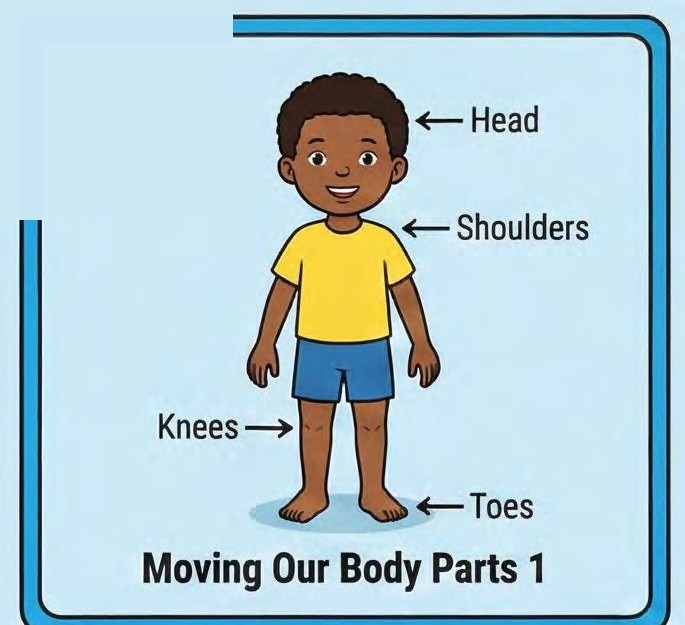
By the end of this lesson, pupils should be able to:
- Point to the upper parts of the body (head, shoulders, arms)
- Point to the lower parts of the body (legs, feet, toes)
- Perform simple movements for different body parts
- Do simple stretches for the arms and legs
The Upper Body
Our body is made up of many parts that work together like a team. The upper body covers everything from our waist up.
- Head: at the very top, holding our brain for thinking, eyes for seeing, nose for smelling, mouth for talking and eating, and ears for hearing.
- Shoulders: the wide, bony parts at the top of our arms, connecting arms to neck and back.
- Arms: we have a left and a right arm, used for lifting, carrying, hugging, and throwing.
- Hands and fingers: each hand has five fingers, used for writing, eating, and clapping.
The Lower Body
- Chest and back: the chest protects our heart and lungs at the front; the back is behind us.
- Waist: the narrow part in the middle of our body, where we bend.
- Legs: a left and a right leg, strong enough to help us stand, walk, run, jump, and kick.
- Feet and toes: each foot has five toes and helps us balance on the ground.
Moving Each Body Part
Head: nodding up and down often means “Yes,” while shaking side to side often means “No.”
Shoulders: shrugging means lifting both shoulders toward your ears, then dropping them — something we do when we don’t know an answer.
Hands and arms: waving side to side says “Hello” or “Goodbye”; clapping brings both hands together to show we’re happy.
Simple Stretches
Stretching warms up our muscles and feels good.
- Sky stretch: stand tall and reach both arms straight up, as if reaching for the sky.
- Toe touch: stand with legs slightly apart, bend forward slowly from the waist, and try to touch your toes without bouncing.
Singing and acting out “Head, Shoulders, Knees and Toes” is a fun way to remember body parts while moving.
Evaluation
- Touch your head.
- Point to your shoulders.
- Show me how you wave your hands.
- Where are your toes located?
- Nod your head up and down.
Assignment
- Draw a stick figure and circle the head.
- Practice touching your toes 5 times at home.
- Sing “Head, Shoulders, Knees and Toes” to your parents.